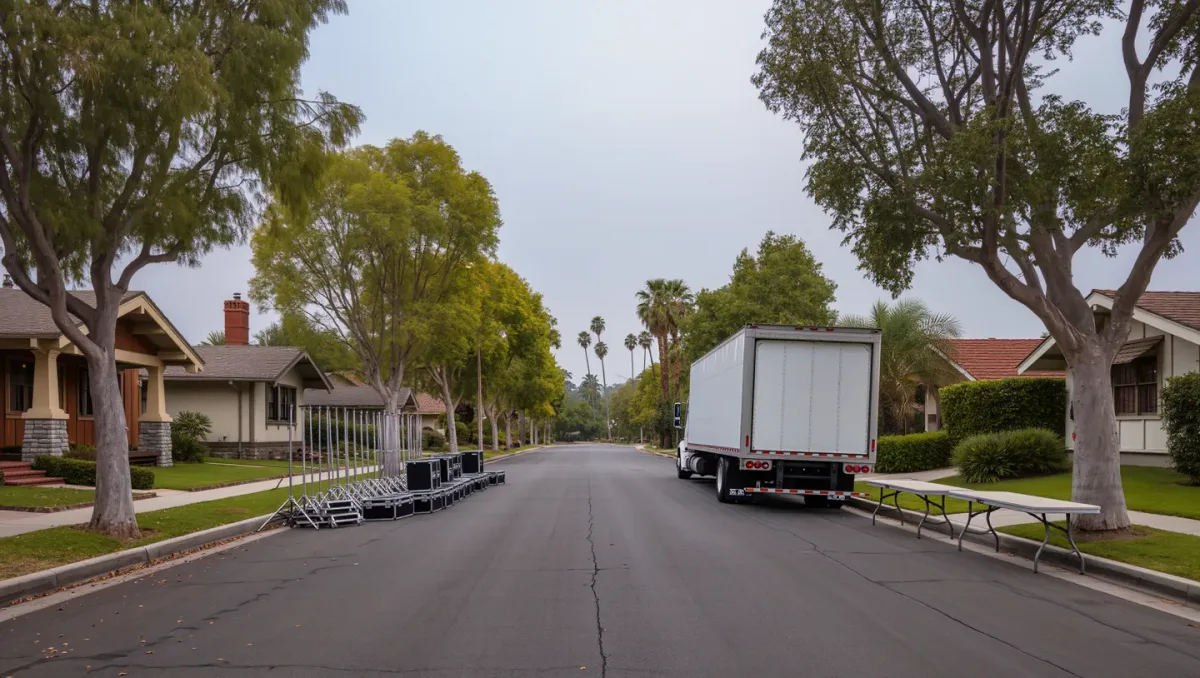
From a hillside in Griffith Park, the film industry looks like a permanent fixture: soundstages, backlots, the basin's geography of production. The employment data tells a sharper story. On-location shooting in greater Los Angeles fell to its lowest level on record in 2024, per FilmLA, the region's film permit office, and the state responded by expanding the Film and TV Tax Credit Program to $750 million a year starting in fiscal 2025-26 — the largest such commitment any state has made to keeping cameras rolling.
How the credit works
The program, run by the California Film Commission inside the Governor's Office of Business and Economic Development, returns a slice of a production's qualified spending — wages for below-the-line crew, payments to in-state vendors — as a credit against California tax. The base credit rate is 25 percent of qualified expenditures, with upgrades to 35 percent for productions shooting outside the 30-mile zone or in economically targeted areas under the newest program generation. Projects are selected through competitive allocation cycles scored on job creation and in-state spending.
Two design features matter for the money. Credits are transferable, meaning productions that cannot use them can sell them to other California taxpayers at a modest discount, which turns the credit into near-cash and lets lower-margin projects monetize it. And the credit applies only to spending inside California, which is precisely the point: every qualified dollar is a dollar that did not leave for Atlanta, Toronto or Budapest.
The expansion to $750 million, signed as SB 132 in 2024, roughly doubled the prior $330 million ceiling. It also extended eligibility to stand-up comedy specials, game shows and animated features, categories the old program excluded.
Why the credit exists at all
California wrote almost nothing down for the industry until other states priced it out. Louisiana launched the first modern film credit in 1992; by the 2000s, New York, Georgia, New Mexico and British Columbia were offering 25 to 40 percent back on qualified spend, and episodic television — the steadiest employment in the business — began leaving Los Angeles in volume. Georgia alone has credited more production spending in some recent years than every state except New York.
California's program began at $100 million in 2009, grew through 2014, and has expanded in most cycles since. Each expansion has followed measurable job loss: the 2023 strikes stopped production for months, and the recovery afterward favored jurisdictions where subsidies and studio-owned stages sit in the same place. Per state employment data, California's motion picture and sound recording employment declined through 2024 and early 2025, with Los Angeles County losing production-linked jobs faster than the state added them anywhere else.
What the numbers actually show
Permits measure the visible half of production. FilmLA's 2024 tally of on-location shoot days in greater Los Angeles ran well below the ten-year average, with episodic television down most sharply — the category that once filled stage space and neighborhood streets year-round. Features and commercials held somewhat steadier, while reality and other non-scripted formats, which never qualified for the credit, drifted to whatever jurisdictions cost least.
Soundstages tell a complementary story. Los Angeles has less purpose-built stage inventory relative to its scripted demand than it did in 1990, and much of the growth in stage construction in the 2010s happened in Georgia, New Mexico and Toronto. The January 2025 wildfires disrupted the year's early schedule across the region, delaying shoots and closing locations in the Palisades and Altadena areas, adding a local shock to an industry already repricing itself.
Who the money reaches first
Production spending is mostly payroll before it is anything else. Industry impact studies of the credit find that roughly two-thirds of qualified spending goes to wages, concentrated among the roughly 100 occupation classifications that staff a scripted shoot: grips and electricians, set decorators, costume supervisors, drivers, sound mixers. Many of these workers operate as independent contractors or through loan-out companies, which means production downturns do not show up as traditional layoffs but as empty calendars — a pattern that makes the pain statistically quieter and financially harder.
The spending also concentrates geographically. Los Angeles County captures the large majority of credited production, but the program's 35 percent uplift exists precisely to push shoots toward places like Kern, Shasta and the Central Valley, where film offices report a few dozen active days a year and every recurring series can anchor a local crew base.
Does the credit pay for itself?
Economists dispute the accounting. A state LAO-style analysis of film credits generally finds that a large share of credited spending would have occurred anyway, and that tax credits return less than a dollar of direct revenue per dollar forgiven. Defenders counter that the relevant comparison is not the credit's direct return but the alternative: the fixed cost of the industry's physical plant — crews, labs, stages, rental houses — leaving the state permanently, as aerospace manufacturing did a generation earlier.
The $750 million program will be tested against a concrete benchmark: whether episodic television shoots in Los Angeles stop declining. That single category carries the highest wage-per-day figures and anchors the crew labor market that everything else, from rental houses to catering trucks, depends on.
What to watch
The Film Commission's allocation announcements through 2026 will show how fast the new money is claimed, and FilmLA's quarterly shoot-day reports will show whether it moved production. If LA episodic days stabilize by late 2026, the expanded credit will be credited; if not, expect another round of proposals in Sacramento, including wage-based incentives aimed specifically at keeping crew jobs in the basin.