The state's ledger for the fiscal year that began July 1 runs to roughly $350 billion in total spending — and the two numbers that define it were set months apart. Governor Gavin Newsom's January 9 proposal projected a $2.9 billion shortfall for 2026-27, small by the standards of recent years, and the May 14 revision declared the state's structural deficit eliminated through mid-2028, per the Governor's budget summary. How a state spends at that scale, and on what tax base, explains both the claim and its fragility.
Where the general fund money comes from
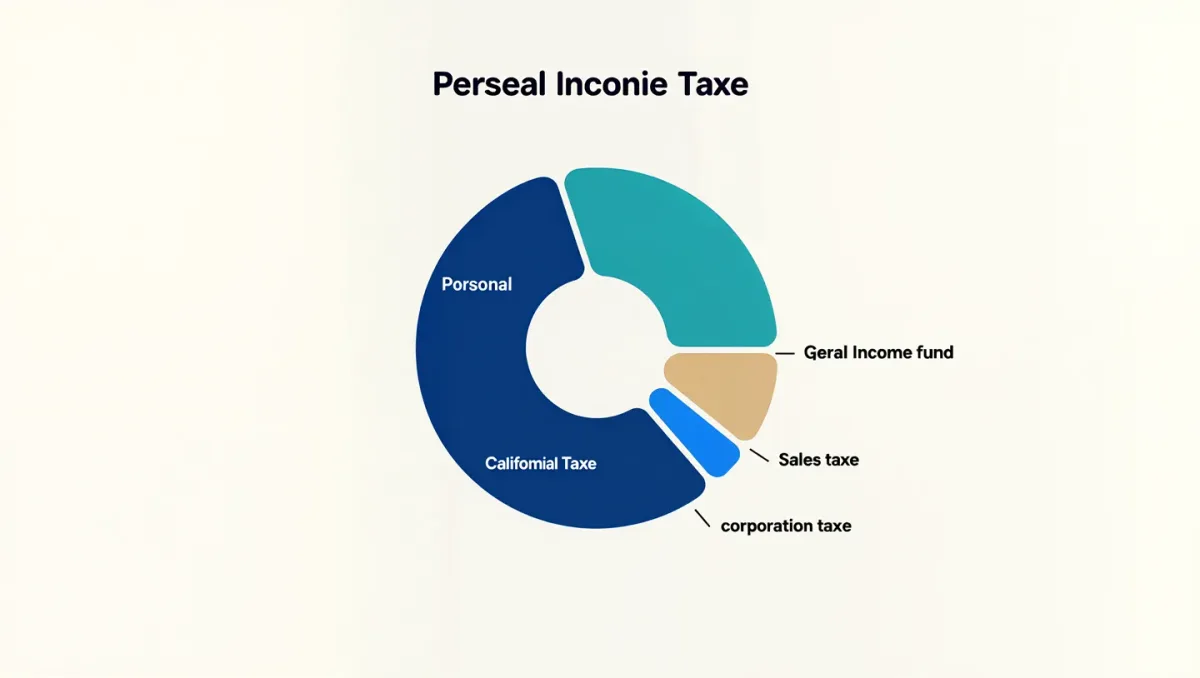
About three-quarters of the state's $200-plus billion general fund comes from two taxes. The personal income tax supplies the majority — roughly two-thirds — and its distribution is steep: per Department of Finance analyses, the top 1 percent of earners has in recent years paid about a quarter of all personal income tax, largely through taxes on capital gains realizations. The sales and use tax adds most of the rest, with corporation tax, insurance taxes and smaller levies filling out the base.
That mix is why Sacramento's budget drama follows the stock market. Capital gains receipts surge with equity markets and collapse with them, as they did after the dot-com bust and the 2022 tech downturn, when projected revenues fell by tens of billions within a fiscal year. No other large state carries comparable volatility; the state's own independent Legislative Analyst's Office has documented the revenue concentration for over a decade and treats it as the central risk in every forecast.
Beyond the general fund sit special funds (gas taxes, fees dedicated by law) and bond funds, which bring total spending authority to the $350 billion figure. Most public attention lands on the general fund, where annual discretion lives.
What the constitution forces first
Roughly 40 percent of general fund spending is not discretionary at all. Proposition 98, the 1988 school funding guarantee, sets a minimum K-14 education share that rises and falls with revenue and enrollment formulas. Healthcare through Medi-Cal, which covers about 15 million Californians, consumes another enormous fixed share. Add debt service and court-mandated spending, and the Legislature each June argues over a relatively small slice of the total — which is why billion-dollar-sounding debates move real programs by single-digit percentages.
Reserves constrain the argument on both ends. Proposition 2, passed in 2014, requires annual deposits into the Budget Stabilization Account, which grew past $20 billion in recent years, plus optional deposits and debt payments. The rainy-day fund is the state's shock absorber, sized by LAO analysis to cover a moderate recession for about a year of typical deficits — a buffer the 2020s have already tested once.
How the process actually moves
The calendar is constitutional and slow. The Governor's budget arrives by January 10; district-level hearings run through spring; the May Revision updates the forecast with actual April receipts; and the Legislature must pass a budget by June 15 or forfeit its own pay under Proposition 25. Trailer bills carry the policy changes, and the Controller signs checks against the final document from July 1 — though the Governor retains line-item veto power over any appropriation, and blue-pencil trims are a routine part of every final deal.
Local governments watch the state document because of its pass-through mechanics. Redevelopment's abolition in 2012 left cities and counties more dependent on state formulas; in-home supportive services, county health programs and trial court funding all flow through budget lines that can shift with a single trailer bill. School districts, governed by the Prop 98 minimum and a local-control funding formula, plan multi-year budgets against state projections they cannot influence — which is why a single downward revenue revision in Sacramento triggers layoff notices in districts from Eureka to El Centro within weeks.
The 2026-27 document specifically
The year's small projected deficit — $2.9 billion in the January plan against recent years' shortfalls of $30 billion and more — reflected both the 2024-25 and 2025-26 rounds of cuts and the revenue recovery that followed the AI-driven market rally. The administration's January proposal repaid $408.4 million in spending deferrals from 2025-26 and avoided broad program reductions; the May revision went further, asserting that ongoing revenues now cover ongoing spending through mid-2028, a claim that rests on continued tech-linked capital gains.
The budget passed by the June 15 constitutional deadline, and the spending plan's politics stayed low-heat compared with 2024's austerity round: higher education absorbed flat budgets rather than cuts, Medi-Cal rolled back some coverage for adults without full immigration status to contain its growth, and no general tax increase accompanied either chamber's proposal. with the usual trailer bills adjusting program rules. Independent analysts — the LAO and the California Budget and Policy Center — noted that longer-run projections still show operating gaps later in the decade, in the billions, once scheduled spending growth outruns the revenue forecast. Eliminating a structural deficit through 2028 is a shorter claim than eliminating it.
What to watch
Three mechanics will test the document. First, quarterly cash reports from the Controller: capital gains collections arrive unevenly and the April and June installments reprice the whole forecast. Second, the reserve balance — whether deposits continue at the Proposition 2 schedule or get redirected, as they were in lean years. Third, the revenue concentration itself: if a market downturn trims the top 1 percent's tax payments by the 30 to 40 percent history suggests is possible, the $2.9 billion problem of January 2026 becomes a familiar multi-year gap, and the structural-deficit claim gets its first real exam.