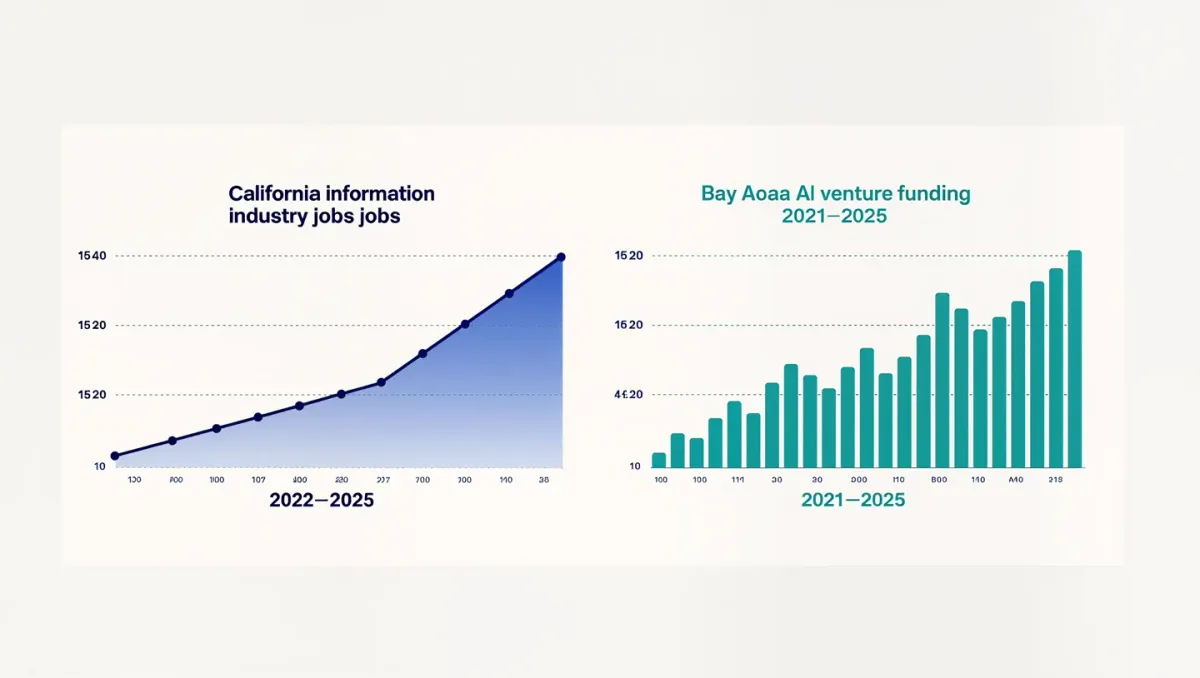
Two hiring pipelines run through the same South of Market office towers. In one, an established software firm posts its fourth restructuring notice of the year under the WARN act file. In the other, an eighteen-month-old AI lab offers signing equity to a database engineer it interviewed twice. Per EDD payroll data, California's information industry has shed tens of thousands of positions since its 2022 peak, while the Bay Area has captured roughly half of global venture funding going to artificial intelligence startups, per PitchBook tallies — a labor market moving in both directions at once.
What the payroll data shows
The Employment Development Department's industry tables put California's information sector — software, media, telecommunications — at roughly 100,000 jobs below its late-2022 high through 2025, a decline of about 10 percent. Professional and business services, the broader category that houses much tech contracting, has been similarly flat. Statewide, the unemployment rate near 5 percent in 2025 remained the highest in the country, per EDD monthly reports, though the state's payroll count kept setting records in other sectors like health care and government.
The declines are heavily geographic. Santa Clara, San Mateo and San Francisco counties absorbed the large majority of tech job losses, and the layoffs skewed toward middle-tenure roles — recruiting, project management, platform engineering — rather than entry-level or senior research positions. That pattern, visible in outplacement firm data and WARN filings, explains a paradox in the numbers: employment fell while advertised salaries for in-demand specialties kept rising.
The AI counter-wave
Artificial intelligence hiring is the strongest regional job engine since the app economy. Stanford's AI Index and Brookings analyses have documented that the Bay Area hosts the largest concentration of AI job postings in the country — more than the next several metros combined — and PitchBook and the Bay Area Council report the region taking roughly half of AI venture funding worldwide. OpenAI, Anthropic and their supply chains of inference, data-labeling and evaluation firms have turned San Francisco's office market from the nation's emptiest into a two-tier one: Class A towers near the Embarcadero fill with AI leases while older stock stays vacant. Per CBRE tracking, San Francisco's office vacancy rate topped 30 percent through 2025 even as AI firms signed some of the city's largest new leases.
The roles are different from the last boom. AI hiring concentrates in relatively few, highly compensated specialties — machine learning engineering, GPU infrastructure, data engineering — and supports fewer positions per venture dollar than consumer software did. An AI lab of 200 employees can absorb hundreds of millions in funding. That is why the funding boom and the payroll decline are not contradictions: money is flowing into fewer, richer jobs.
The geography inside the region
Average the Bay Area and you miss the sorting happening within it. San Francisco's share of AI-lab hiring has made it the rare big city gaining young college-educated residents again, per census population estimates released in 2025, while parts of the South Bay and the East Bay's older corporate campuses sit emptier than in 2019. Downtown San Jose, Walnut Creek and Pleasanton office districts still run well below pre-pandemic occupancy, and transit ridership on some commute corridors remains about two-thirds of 2019 levels, per transit agency reports.
Remote and hybrid work explains part of the divergence. Engineering roles are the most remote-tolerant in the economy, so a Palo Alto-headquartered company can now hold its headcount constant while its local payroll shrinks through attrition. The EDD counts jobs where employers report them, but payroll location increasingly lags where work actually happens, and multi-state remote hiring quietly shifts income tax residency year by year.
How to read the indicators
Three data series separate signal from noise. EDD's monthly industry employment counts measure actual payrolls but lag and get revised; they are the base number. WARN act filings list mass-layoff notices by company and county, useful for tracking specific employers in real time. And quarterly venture funding tallies show where the next hiring wave will land about four quarters ahead, since funded startups staff up after the round closes.
One caveat runs through all of them: much tech work no longer sits in tech employment counts. Designers, marketers, finance staff and operations people at software companies are classified across other industries, and the shift to contractors and staffing agencies moves roles out of tech payrolls entirely without anyone losing a job.
Entry-level dynamics add a third layer. Hiring for new graduates has thinned across software, per university career-center surveys and campus recruiting data through 2025, as automation of routine coding tasks and the 2024-2025 retrenchment cut the junior rungs of the ladder hardest. Compensation for the newest engineers who do land offers remains high, but the volume of first positions is the lowest in a decade, which matters for how the state's universities pitch the industry to students.
What this changes for a California reader
For workers, the market rewards switching costs differently by track: a mid-career infrastructure engineer faces a real hiring contraction, while an ML specialist fields multiple offers. Retraining programs, including CalHHS-adjacent and community-college certificates in data work, have expanded in response, and the state's Employment Development Department lists AI-adjacent roles among its fastest-growing occupational projections through 2030.
For the state treasury, the mix shift matters: software payrolls fund a disproportionate share of California's personal income tax, and the top 1 percent of earners — heavily tech — supply roughly a quarter of general fund revenue, per Department of Finance analyses. Watch whether AI payroll growth starts showing up in the EDD's information sector line by late 2026. If it does, the two-speed market is converging; if not, the budget will keep carrying the risk of a concentrated boom.