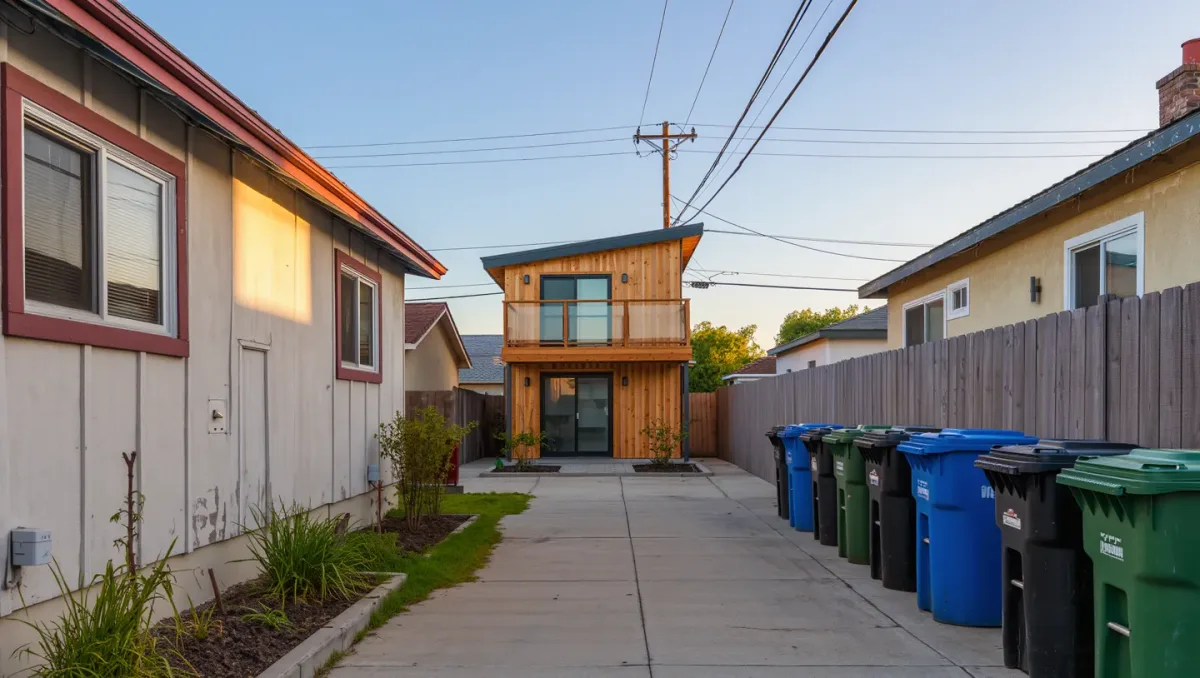
Down the alley behind a Culver City bungalow, a contractor's crew frames a two-bedroom unit that will be its own legal address by summer — no variance, no discretionary hearing, no neighbor's signature required. Statewide, permit counts for accessory dwelling units rose from roughly 1,200 in 2016 to more than 20,000 a year by the mid-2020s, per the state housing department's data, making ADUs the fastest-growing slice of California's housing production.
Local ordinances layer on top of state law, and lot-specific constraints decide what any single property can hold.
The rights state law now guarantees
A string of bills between 2017 and 2024 rewrote who decides. The core rule, completed by AB 68 and AB 881 in 2020, is ministerial approval: if a proposed ADU meets objective standards, the city must approve it within 60 days without hearings, environmental review or a finding that neighbors object. Local governments cannot require the owner to live on the property — a prohibition AB 976 made permanent — cannot require replacement parking when a garage converts, and must waive parking entirely within a half mile of transit.
Size rules have a state floor. Every lot zoned for single-family use can build at least one detached ADU of up to 800 square feet that a city may not shrink, and SB 897 in 2022 raised the height ceiling to 18 feet, or 25 feet within a half mile of major transit, enough for a two-story unit. Attached ADUs and conversions follow proportionality rules, and every lot may also add a junior ADU — a converted bedroom with its own entrance and kitchenette — alongside a full ADU.
Fees were the second front. SB 13 in 2019 barred impact fees on ADUs under 750 square feet and required cities to scale fees proportionally above that line; utility connection charges were capped for conversions of existing space; and cities must now host pre-approved plan programs, where homeowners pick a vetted design and skip the months of plan-checking that once preceded approval. Assembly Bill 1033 added a 2024-onward option for cities to let ADUs be sold as condominiums, separately from the main house, where local ordinances allow.
What the boom changed on the ground
The production numbers understate the shift in who builds housing. Most ADU applicants are homeowners, not developers: a retiree building a unit for a caregiver, a family housing a grown child, or an owner renting to cover a mortgage. State surveys found a large share of completed ADUs house family members, with rental income the secondary motive — a housing program that runs through inheritance, caregiving and household economics rather than through the apartment market.
Los Angeles built more ADUs than any city in the country, and its experience shaped the 2020 laws: early LADWP fee interpretations and parking rules had strangled the 2017 pilot generation, and the city's pre-approved standard plan program later became the state template. San Diego's decision to allow unlimited ADUs on transit-served lots — a step beyond state law — produced its own construction wave and its own court challenges from neighborhoods.
The limits of the model
ADUs are cheap per unit and small in aggregate. At 600 to 800 square feet each, even 25,000 permits a year add well under 2 percent of the state's estimated housing need, and construction costs — commonly $200,000 to $400,000 per detached unit — put ownership financing out of reach without home equity or the state's ADU grant and calHFA loan programs. Wildfire-prone and hillside lots face their own utility and egress constraints that no preemption bill overrides.
Enforcement drift is the quieter risk. Cities occasionally adopt objective standards so restrictive — setbacks, lot coverage, solar requirements — that they function as vetoes, and the housing department has issued violation letters after review cycles. The cure so far has been another bill; the pattern has held every session since 2016.
How financing actually happens
The state recognized early that entitlement rights mean little without capital. The calHFA ADU grant program has offered homeowners up to $40,000 toward pre-development costs — plans, permits, site preparation — paired with construction loan products, and several local utilities and cities layered rebates for garage conversions onto it. Lenders moved more slowly: appraisers had little comparable sales data for backyard units, and conventional loan products assumed a single dwelling per property, so many early ADUs were financed with cash-out refinances or renovation loans rather than purpose-built mortgages.
Rentals changed household math where they appeared. A detached unit renting near market rate can cover a meaningful share of a mortgage payment, which is why ADU construction has tracked high-price coastal metros far more than inland counties — a distribution that worries housing economists, who note the state's neediest rental markets are the ones where the backyard economics work worst.
What to watch
Homeowners' associations cannot block ADUs outright either — covenants that conflict with the state rules are void — though architectural review of exterior finishes survives in limited form. Three things will show where the ADU experiment goes next: whether AB 1033 condo-sales ordinances spread beyond the pilot cities and create a real market for separately owned backyard units; whether state grant programs survive future budgets to keep financing within reach of non-wealthy owners; and the permit counts themselves, which the housing department reports annually. The laws turned California's backyards into its most productive zoning category. Whether they can keep that title is a budget and enforcement question, not a design one.