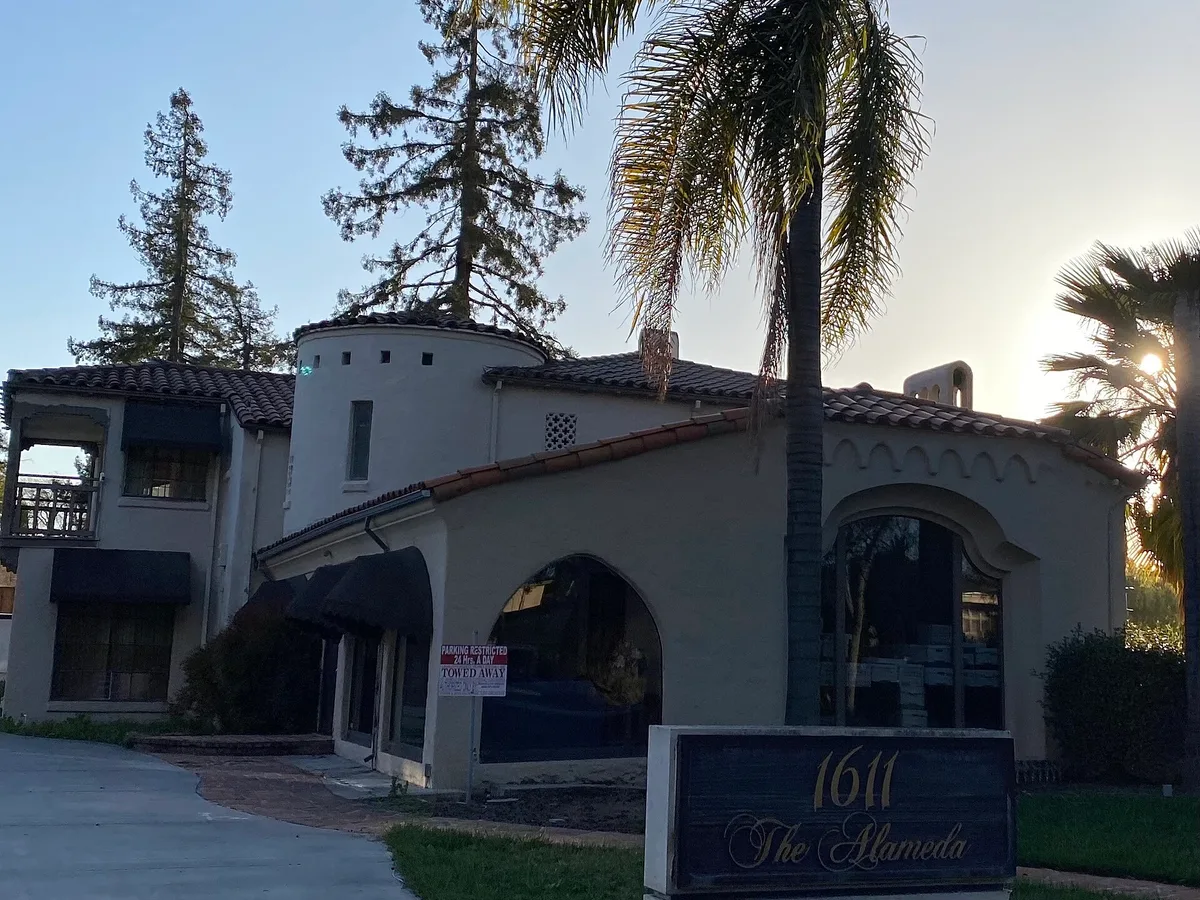
Mission Revival is the white-walled, red-tiled architecture of shaded arcades and curved gables that reads, at a glance, as Californian. The style borrowed its shapes from the 21 Franciscan missions established across the state between 1769 and 1823, and its main run as a fashion lasted from about 1890 to 1915. Railroads, schools, hotels and campuses carried it across the West and far past it.
The look began as a regional turn away from imported taste. Late in the 19th century, California architects started treating their own surroundings as source material rather than copying the East Coast, and what surrounded them was mission country: thick chapels, plain plaster, bell walls, clay tile. Readers following this should also see How San Diego Brewed a Neighborhood Industry Worth Billions.
What Does the Style Actually Look Like?
Mission Revival buildings copy the missions' practical forms, not their materials. a National Park Service style guide lists flat, unadorned stucco surfaces with few openings, low roofs on wide overhanging eaves, red clay tile, and thick arches. The curved or scalloped gable is the signature move, often paired with a small bell tower. Decoration comes from shadow: the guide notes that lines cast by roof overhangs on plain walls were often the only ornament a building had.
Why Did California Architects Turn to the Old Missions?
The Park Service dates the turn to the late 19th century, when designers here decided the state's own history was worth building from rather than around. the standard survey entry on the style adds a second driver: nostalgia, in a quickly changing state, for a simpler time, a mood the novel Ramona fed. Restoration crews were patching the real missions at the same time, so revival and preservation grew up together. The missions themselves were adobe; the revivals were stucco over modern construction, shaped by the earthquake codes of their day, so the arches and gables work as decoration rather than structure.
How Did the Look Spread Across the West?
Railroads did the carrying. The guide records that the style became visible across the West as the Santa Fe and Southern Pacific railways adopted it for stations and resort hotels. Prominent California ground followed: the Stanford University main quad, completed in 1891, and the Southern Pacific depot in Burlingame, finished in 1894, both used it. The survey's example list runs from houses to schools and depots, and past the state line to a Harvey House hotel in New Mexico, opened in 1899, and a Kentucky distillery built in 1910. The fashion even crossed the Pacific; in Australia, builders knew the look as Spanish Mission.
Where Can You See It in California Today?
Plenty of places, and several are working buildings. The Mission Inn in Riverside is one of the largest surviving Mission Revival buildings in the country. The Santa Fe Depot in San Diego opened its curved gables to travelers in 1915. A. Page Brown, who moved his office to San Francisco in 1889 and later designed the city's Ferry Building, is credited with introducing the style to Santa Barbara, where his Garden Street houses started a look the city kept. At the Presidio in San Francisco, Fort Winfield Scott's barracks and headquarters went up in 1912 with plain white walls and red tile roofs. The Davis train station followed the pattern in 1914. The San Gabriel Mission Playhouse opened in 1927.
Conclusion: A Borrowed Silhouette That Became California's Own
The fashion itself was brief. By the mid-1910s the style was yielding to its successor, Spanish Colonial Revival, and the example lists thin out after the 1920s. What it left is a template that still works: plain stucco, clay tile, deep shade, a curved gable against the sky. The people it reaches now are the homeowner pricing tile for a 1912 bungalow, the commuter crossing a shaded arcade in San Diego, and the planner deciding whether an old depot earns another century of use. We covered a connected angle in The Hollywood Sign Was an Ad for Houses. A Century Later It Still Works.