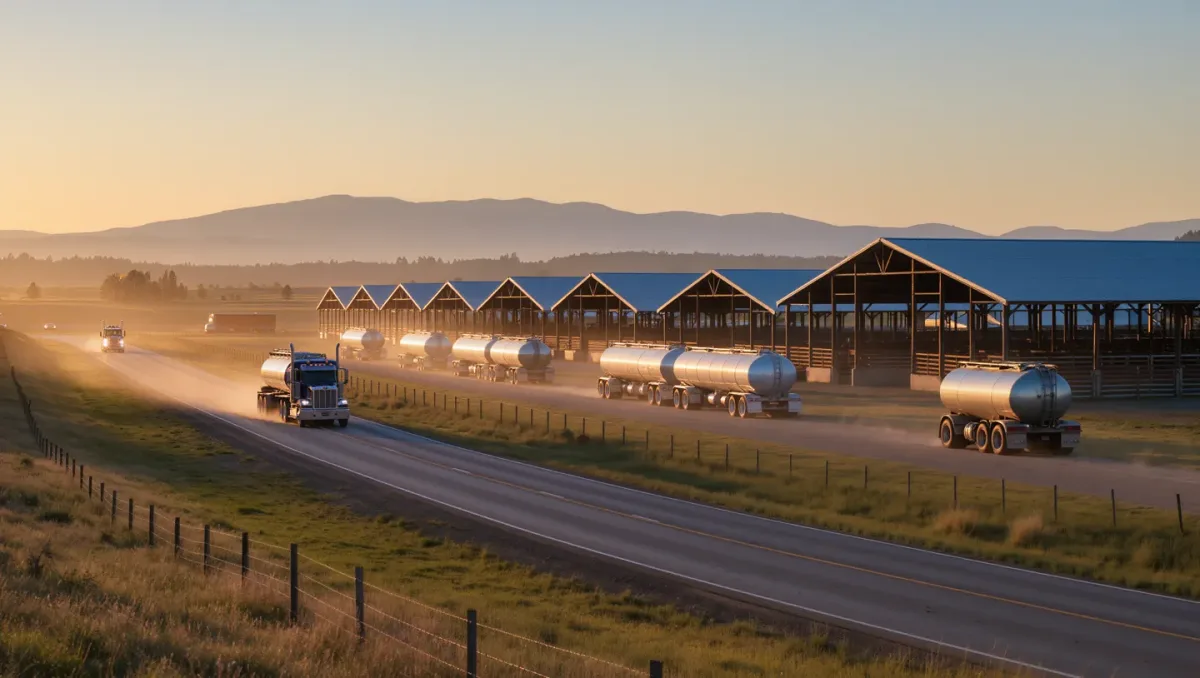
Before sunrise in Tulare County, tanker trucks already run the county roads between freestall dairies, collecting milk that will be cheese by afternoon and, for roughly a fifth of the state's production, a shipping container at Oakland within the month. California remains the largest milk-producing state in the country at more than 40 billion pounds a year, per CDFA data, and dairy is the state's single most valuable agricultural commodity group — worth around $8 billion at the farm gate in recent years.
A consolidation story told in barn count
The structure of the industry has changed faster than its output. California counted around 2,000 licensed dairies in the mid-1990s; the count now sits near 1,100, while total production rose. The average herd grew from a few hundred cows to well over a thousand, and the geography concentrated: Tulare County alone produces more milk than most states, with Merced, Stanislaus and Kings counties close behind.
The economics push in one direction. Milk is priced on federal and state marketing-order formulas tied to cheese and powder markets, feed is the largest cost, and margins per cow are thin. Scale spreads feed procurement, herd management and compliance costs across more animals, so each cycle of low prices removes the smallest operations first. Cooperatives — California Dairies Inc. is the largest, with hundreds of member farms — process and market most of the state's milk and have themselves consolidated plants toward higher-value products.
Where the milk actually goes
Liquid milk is a shrinking slice of demand. The growth products are cheese, butter, skim milk powder and whey — the ingredients of global food manufacturing — and California has built processing capacity accordingly, becoming one of the country's largest cheese producers with mozzarella plants serving national pizza chains from the Central Valley.
Roughly 20 percent of California's milk solids leave the country. Dairy exports were worth about $2.3 billion in recent years, per the California Dairy Research Foundation and industry trackers, with Mexico the largest single customer for cheese, Southeast Asia and the Middle East major buyers of powders, and China the swing market whose buying pace moves farm-gate prices. Tariff fights matter here: Mexico's market is protected by the USMCA framework, while retaliatory tariffs in China during the trade conflicts of recent years redirected powder cargoes and squeezed margins within a season.
The price machine behind the farm gate
Milk pricing confuses outsiders because no one sets a price at all. California dairies sold under a state order until 2018 and now operate under federal marketing orders, formulas that derive a "mailbox price" from wholesale cheese, butter, powder and whey markets, minus handling costs. The producer price floats monthly, which means a dairy's revenue for a given month is determined by commodity trades that happened weeks earlier, and hedging through futures has become standard for larger operations.
Feed works the same way in reverse. Corn, soybean meal and alfalfa are globally traded commodities, so California herds eat international prices while shipping costs add a premium for the state's imported share of feed. The industry's profitability is therefore a spread business — the distance between two moving world markets — and the 2015, 2020 and 2023 price collapses each triggered the same sequence: negative margins for six to twelve months, then a culling wave and another step down in the licensed dairy count.
Methane, digesters and the new compliance layer
No commodity carries a climate mandate the way California dairy does. SB 1383, passed in 2016, requires the state to cut dairy manure methane 40 percent below 2013 levels by 2030. The state's chosen instrument is the dairy digester: lagoons capped and connected to gas processors that pipe or truck renewable natural gas into fuel markets. The CDFA has awarded several hundred million dollars in state and federal funds to more than a hundred digester projects, and clusters of dairies around Tulare now sell pipeline-quality gas under long-term utility contracts.
Digesters changed farm balance sheets as much as emissions profiles. A digester contract can be worth more per year than the milk from the surrounding cows, which is why every dairy trade publication now reads partly like an energy journal. The alternative compliance path — pasture-based and herd-reduction strategies — remains contested between environmental groups and the industry, and the 2030 deadline will test whether voluntary state-subsidized projects add up to the required reduction.
Labor adds a quieter constraint. Milking runs twice a day on schedules that do not pause for immigration policy, and industry surveys have long found that a large majority of California dairy workers were born outside the United States. Wage floors, overtime rules that phase in for agricultural workers, and workforce stability weigh on the cost side of every herd, feeding the same consolidation pressure that low prices do.
Water, land and the next decade
SGMA groundwater limits, the same rules squeezing almonds, reach dairies through feed: much of the corn silage and alfalfa that feeds valley herds grows on the same overdrafted basins, so as pumping allocations tighten, feed acres retire or prices rise. Industry analysts have begun modeling herd contractions in the San Joaquin Valley as a water story, with milk production migrating toward feed-secure regions.
Watch three signals through 2026: the CDFA digester funding rounds and how close cumulative projects get to the SB 1383 target; Chinese powder purchases, the fastest-moving variable in farm-gate prices; and the licensed dairy count, which remains the cleanest single indicator of the consolidation that has defined the industry for thirty years.