Proposition 4, the $10 billion climate and infrastructure bond on the November 2024 ballot, passed with about 59 percent of the vote, per the Secretary of State's Statement of Vote, and it works like every California general obligation bond: the state borrows $10 billion, spends it on specified programs, and repays principal plus interest from the general fund over decades. The largest slices, roughly $3.8 billion for water projects and about $1.5 billion for wildfire prevention, give the measure its practical shape, with the balance spread across sea-level rise response, parks, clean energy, and agriculture.
This explainer covers what the bond contains, how bond repayment shows up in the state budget, and where the money has been heading since it took effect.
What is a general obligation bond?
Unlike a law that spends existing revenue, a general obligation bond is long-term borrowing that voters must authorize under the state constitution. The state sells bonds in phases, agencies and grantees draw the proceeds, and debt service, principal plus interest, becomes a fixed charge on the general fund each year. Interest over the life of a bond can roughly match the principal, which is why fiscal analysts total bond costs at multiples of the headline number; the nonpartisan Legislative Analyst's Office put typical repayment costs for measures of this size in the range of $1.5 to $2 billion a year for decades, depending on interest rates and sale pacing.
Voters accept this arithmetic in exchange for speed: bonds fund construction and grants now, and the bill arrives spread across the years the infrastructure serves.
How the money actually moves
Bond mechanics matter for readers following the projects. The state sells bonds in periodic tranches through the Treasurer's office, typically over several years, and each program category releases funds through agency guidelines: the Natural Resources Agency, the Department of Water Resources, Cal Fire, and others publish grant rounds with application windows, scoring criteria, and match requirements. A city applying for watershed money navigates a different pipeline than a land trust applying for coastal funds, and the guidelines, not the ballot text, decide the fine print. Oversight runs through existing channels: the Analyst's office and the Controller review expenditures, and agencies report allocations publicly, though watchdogs have long noted that bond-funded programs are easier to audit than the outcomes they target.
The repayment side also moves visibly. Debt service appears as a standing line in the annual budget, and state revenue formulas approved by voters since the late 1980s treat general fund obligations, including bond payments, as the first claim before the education funding guarantee is calculated. That sequencing is why bond measures pass with comfortable majorities: the costs are real but arrive distributed, while the projects are local and specific.
What does Proposition 4 fund?
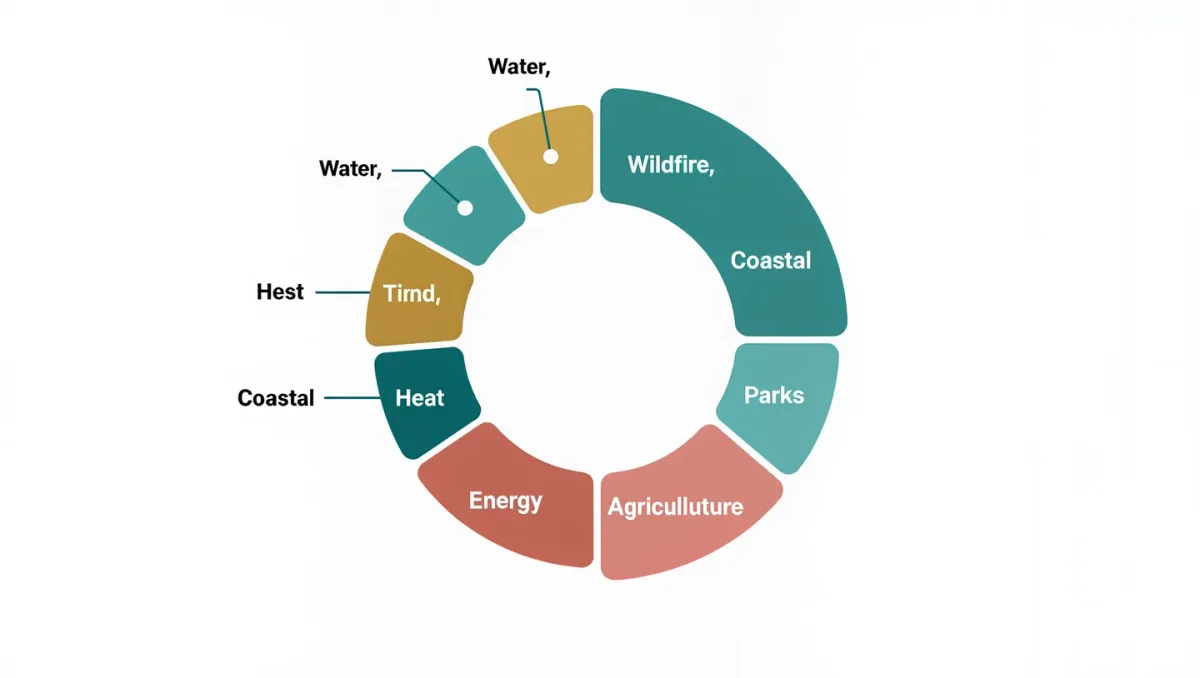
The bond, passed as Senate Bill 867 and placed on the ballot with legislative supermajorities, allocates its $10 billion across climate resilience categories that the Legislative Analyst's summary described as follows: the largest single allocation, roughly $3.8 billion, goes to safe drinking water, water supply, and watershed work; about $1.5 billion funds wildfire prevention and forest health; more than a billion addresses sea-level rise and coastal resilience; and the remainder funds extreme heat response, parks and green space, clean energy and air quality projects, and agriculture and food systems. A notable structural feature: a substantial share flows as grants to local governments, tribes, and community organizations rather than through state construction, meaning much of the spending decision-making sits below the state level.
| Category | Rough allocation |
|---|---|
| Water, drinking water, watersheds | about $3.8 billion |
| Wildfire prevention and forest health | about $1.5 billion |
| Sea level rise and coastal areas | over $1 billion |
| Heat, parks, energy, agriculture | remainder of the $10 billion |
How does it fit the budget?
The bond arrived after years of climate spending built from the general fund directly, which the state did aggressively during the surplus years of the early 2020s and could not sustain when revenues sagged. Borrowing is the alternative: it preserves annual discretion while locking in multi-year programs. The trade-off reads plainly in every budget since, where debt service on past bonds, from Proposition 4 and its predecessors, competes with schools, health, and corrections for the same fund. Fiscal watchers track the state's debt-to-revenue ratio for that reason; the Analyst's office publishes the running total of outstanding bond debt each year.
For local readers, the practical entry point is the grant calendar. Cities, water districts, tribes, and nonprofits that follow the agency guidelines have a running menu of application windows through the bond's spending years, and the pattern of awards, announced by agency and region, will be the clearest public record of whether the money reaches the communities the campaign described. Early rounds favored jurisdictions with ready project lists and matching funds, a bias that advocates say shortchanges small rural and low-income applicants unless the guidelines set aside a share for them, an argument that shaped the statutory set-asides embedded in the measure's text.
What to watch
Watch the pace of bond sales and grant awards through 2026 and 2027, because the ballot measure authorized the borrowing but appropriations and agency guidelines shape who actually receives it, and watch the interaction with wildfire funding, where Prop 4's forest-health grants overlap with the state's fire prevention fee system. Bonds commit the state to a decade of climate adaptation; the annual budget documents will show whether the projects keep pace with the climate itself.