California's state budget, which has run above $290 billion in recent years per Department of Finance figures, must pass by June 15 under the state constitution, or legislators forfeit pay and expenses for every day past the deadline, a rule voters added with Proposition 25 in 2010. The new fiscal year begins July 1, and the month between the constitutional deadline and the fiscal clock is when the Governor signs the bill, usually with a stack of trailer bills that carry the real policy changes.
This explainer walks through the budget calendar, the constitutional rules that shape it, and the strange hybrid in which a single person proposes the spending plan but 120 legislators must pass it.
What is the budget calendar?
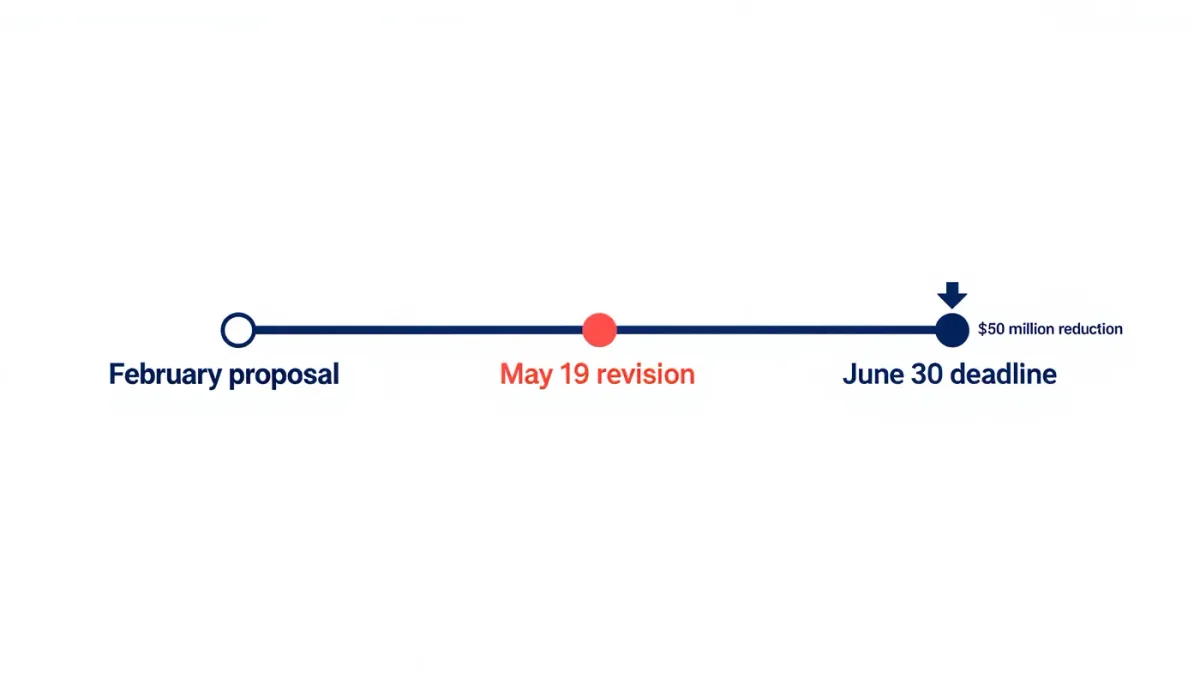
The script has three fixed scenes. In January the Governor submits a proposed budget built on revenue forecasts and department requests, a document of hundreds of pages that sets the negotiating frame. In May, when income tax receipts give the first true reading of the year's revenue, the Governor issues a revised proposal, the May Revision, which historically carries the year's real news, since January guesses become May facts. The Legislature then negotiates with the Governor's finance department, passes a budget bill by June 15, and the Governor signs it, with line-item veto power over any appropriation, by the start of July.
Most years the schedule slips in practice: the June 15 bill arrives, a clean-up budget follows in late June, and trailer bills continue appearing into the summer. But the constitutional deadline has held since 2010 in a way the old July 1 deadline never did, because the pay penalty is personal and immediate.
What does balanced budget mean here?
The constitution requires the Legislature to pass a balanced budget, where projected spending does not exceed projected revenues and funds, but the balance rests on forecasts, not cash. The proposal and the enacted plan can both be wrong about revenue, which is why the state's fiscal history runs in surges and squeezes rather than steady lines. Two voter-added mechanisms manage that uncertainty: Proposition 2, passed in 2014, channels revenue spikes into the Budget Stabilization Account, the rainy day fund, with formulas for deposits and withdrawals, and the state's legislative analyst each year publishes whether the budget pencils out on its own assumptions.
| Date | Budget event |
|---|---|
| January 10 | Governor proposes the budget |
| May 14 (approx.) | May Revision updates the revenue picture |
| June 15 | Constitutional deadline; legislators' pay at risk |
| July 1 | Fiscal year begins |
Who actually writes the numbers?
The Governor's Department of Finance builds the proposal; the nonpartisan Legislative Analyst's Office scores it; the budget committees in each house, joint in structure, rewrite it; and the Big Three, the Governor, the Assembly Speaker, and the Senate President pro Tempore, cut the final deal, often in closed rooms during the June sprint. Subcommittees hold most of the public hearings in spring, but the final week belongs to leadership. Interest groups flood the process: education coalitions, health providers, local governments, and organized labor each track specific lines, and the trailer bills that implement policy changes attract their own lobbying seasons.
The Controller signs the checks but does not shape the plan; once enacted, spending flows under the Controller's warrants and the state's accounting, and the annual audit cycle follows the money after the fact.
Why trailer bills carry the news
The budget bill itself is mostly appropriations tables; the policy lives in trailer bills, the companion legislation that changes statutes to implement the spending plan. That is where major shifts have arrived in recent years: expansions of health coverage, new tax credit structures, and program reorganizations all rode budget trailers because the two-thirds-vote rule for taxes and the urgency clause make the budget context legislatively efficient. The 2025 expansion of the film and television tax credit to $750 million a year, for example, passed as a budget trailer bill on June 27, 2025, per legislative announcements at signing.
The trailer system has a governance cost, though. Policy questions that would draw full hearings in ordinary bills move on the budget clock, with amendments landing in the final days and public scrutiny compressed. Good-government groups have pressed for earlier posting and longer review windows, with mixed success, and the Analyst's office regularly notes that the June sprint concentrates decisions that deserve the whole session.
For readers following any specific program, the practical guide is this: the January proposal tells you the ambition, the May Revision tells you the money, the June bill tells you the deal, and the trailer bills tell you the rules. Reading them in that order turns an opaque process into a legible one.
Local governments watch a specific corner of this process for their own solvency. The budget allocates realignment funding that supports county health, social services, and jail programs, sets mandate reimbursements, and shifts program costs between the state and the 58 counties, so a line that looks abstract in Sacramento translates directly into county service levels from Crescent City to El Centro. School funding runs on the same clock through the Local Control Funding Formula, which distributes the education article of the budget by district characteristics, and any mid-year cut to that formula ripples into classroom staffing within a single school year. The June deal, in other words, is not an abstraction at the end of the process; it is the year's operating budget for most of California's public institutions, and the deadline exists precisely because so much depends on the state's books closing on time.
What to watch
Watch the May Revision first: it is the year's real forecast, and the distance between the January number and the May number tells you whether June will be a negotiation over growth or over cuts. Then watch the reserve: the size of the rainy day fund under Proposition 2's formulas bounds how the state absorbs any revenue miss, and the budget documents publish the arithmetic in plain sight each June.