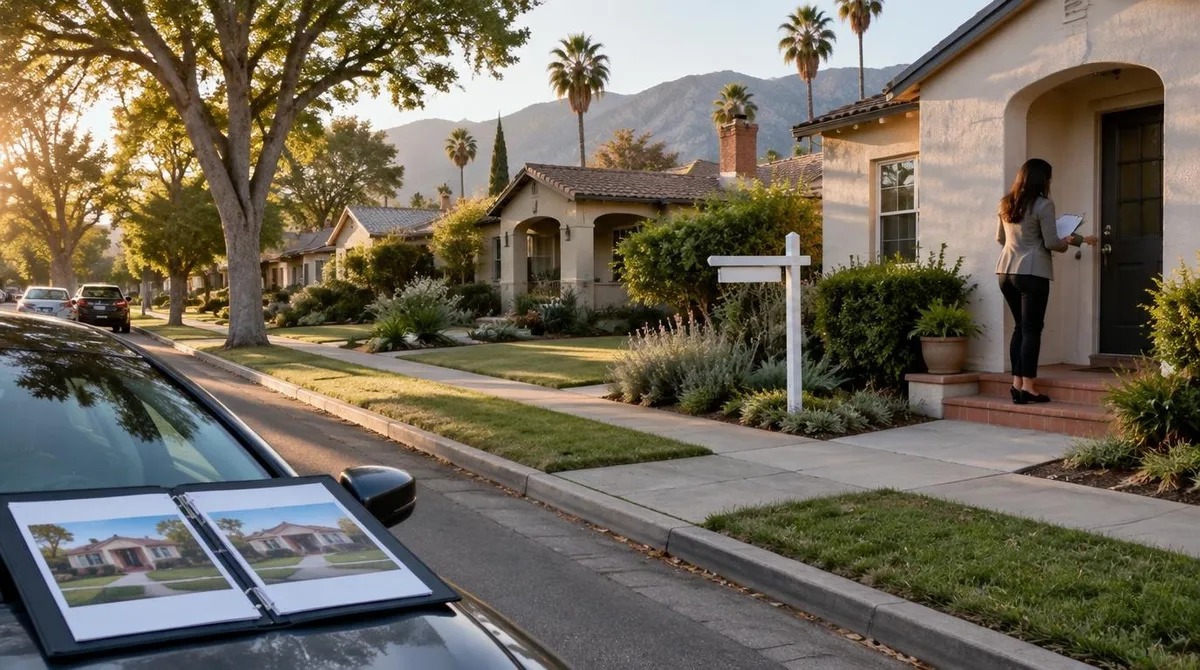
Home prices in California change from block to block because buyers are paying for what sits around a house, not just the house. School lines, zoning, tax history, and hazard maps redraw the value of an identical building every few hundred feet. The gap can be real money in a state where the median single-family sales price was just shy of $900,000 in July 2025, according to the state association of Realtors, as reported by CalMatters.
Two houses with the same floor plan can sit in different markets. One faces a park in a quiet zone for single-family homes. The other borders a four-lane road on a block where apartments are allowed.
What Are You Actually Paying For When You Buy?
A house is a box of lumber on a parcel of land, and in most California cities the land is the expensive part. Buyers bid up parcels that carry rights and perks: a bigger yard, a shorter drive, a school people want. They discount parcels that carry costs: flood insurance, fire risk, traffic noise. That is why the lot, not the kitchen, decides most of the price. A remodeled kitchen on a risky block still sells below a tired kitchen on a prized one. Readers following this should also see California's Median Home Price Is Nearly $850,000. Read It Carefully.
Do School Attendance Lines Move Prices?
They can, and the line is often literal. Districts assign homes to schools by boundary maps, and two houses across one street can land in different attendance zones. Families pay for the school, not the house, so offers run higher on the side with the stronger campus. If you are comparing homes, check the attendance boundary with the district itself, because listings get this wrong.
How Does Proposition 13 Freeze a Block in Place?
Proposition 13, approved by voters on June 6, 1978, caps the general property tax rate at 1 percent of assessed value and limits yearly assessment increases to 2 percent until the property sells or is rebuilt, under Article XIII A of the state Constitution. The rule creates neighbors with very different tax bills. A Lincoln Institute of Land Policy analysis, cited in a July 2025 CalMatters report, estimated that new buyers in many of California's largest cities pay more than twice the property taxes of a typical long-time owner on the same kind of home.
That gap changes behavior, and the behavior changes prices. Owners with a low tax base have one more reason to stay put, so desirable streets turn over slowly and listings stay scarce. Federal Housing Finance Agency numbers cited in the same report put the cost of trading an old mortgage for a new one at $675 a month for a typical California borrower. Scarce supply on a sought-after block pushes the few sales that happen to higher prices. This connects to our earlier piece, Proposition 13 at Nearly 50: How California's Property Tax Actually Works.
Which Map Lines Reset the Price?
Zoning is the big one. A block zoned only for single-family homes has a fixed supply of lots, while a block where apartments are allowed can change form, and buyers pay for that option in both directions. Hazard maps do the same work. A parcel inside a high fire hazard zone faces costlier insurance, and a parcel in a flood zone carries a federal insurance requirement that lenders enforce. Freeway noise, flight paths, and busy corners each shave offers. On the upside, a deep lot with room for a second small unit can draw income-minded bidders.
How Should You Compare Two Blocks Before You Bid?
If you are deciding between two streets, run the same four checks on each. Pull the property tax history, because the seller's bill tells you nothing about yours after a sale resets it. Confirm the school boundary and the zoning with the city, not the listing. Look up the fire and flood designations, then price the insurance before you offer. Walk the block at rush hour and count what you hear.
Conclusion: The Block Sells the House
California housing prices are block by block because the state's rules are block by block: one zoning code, one school line, one tax history, one hazard map at a time. A first-time buyer who learns to read those lines can find the street where the same money buys more. A longtime owner who stays put pays for the choice in taxes forgone but keeps a life priced in decades. The family that crosses one street and saves six figures, or pays them, is reading the same maps the appraiser is.