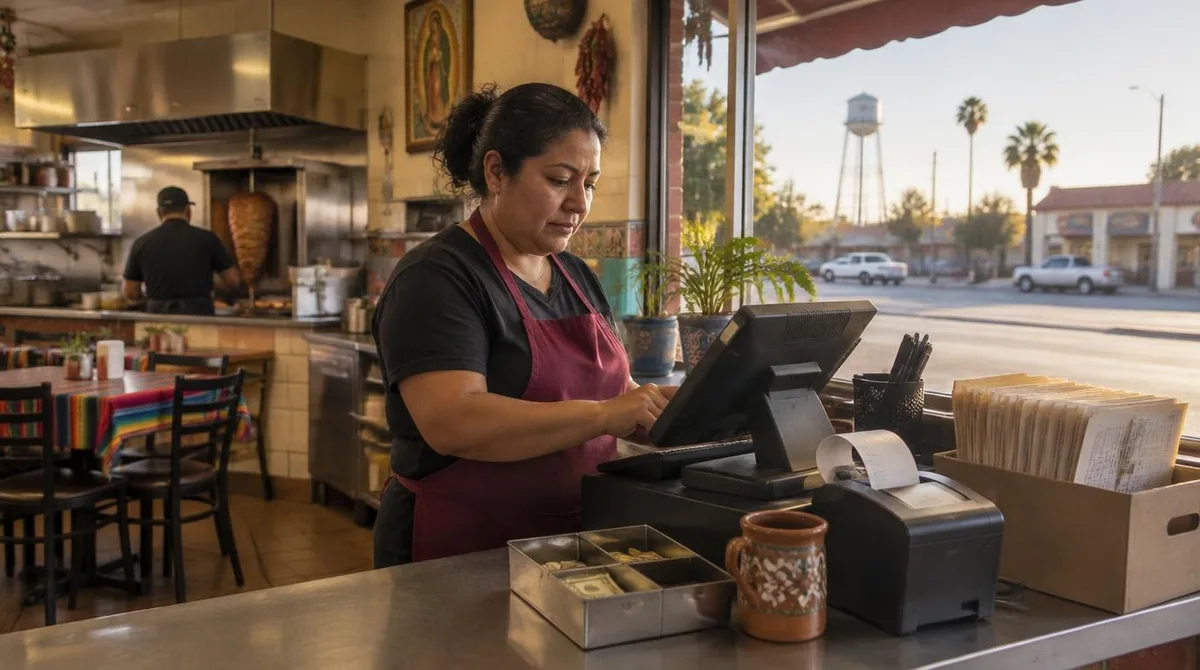
Walk into a taqueria on a Tuesday afternoon in Fresno and the register is already doing state work. Every taxable ring-up adds sales tax on top of the menu price. The owner collects it, holds it, and then sends it to Sacramento on a schedule set by the state.
California's sales tax is not one flat number. It is a base rate the state sets, plus district taxes that cities, counties, and special districts add on top. That is why the total at the counter can differ from one block to the next. The business, not the customer, is responsible for getting that math right and passing the money along.
This piece walks through how the system works: who has to register, how the money gets remitted, what filing schedule a shop lands on, and the special wrinkles that hit restaurants and online sellers. The rules here come from general, durable features of the system. For the exact rate in your city and the current forms, check the state tax agency directly before you file. We covered a connected angle in How California's Unemployment Insurance System Actually Works.
Who has to register, and with whom?
The California Department of Tax and Fee Administration, usually shortened to CDTFA, runs the sales and use tax system. If you sell tangible goods in California — a shop, a food truck, a furniture maker shipping to a customer — you generally need a seller's permit before you make your first taxable sale. The permit is how the state knows who owes what.
Registering is a paperwork exercise, not a license fee in most cases. You apply with the CDTFA, describe what you sell, and the agency assigns you a filing schedule. Service businesses are a different story. A barber or a consultant generally does not charge sales tax on the service itself, though if the job includes selling goods — a salon that sells the products it uses — the line between taxable and not gets blurry fast.
What this means for a new owner is simple: figure out your registration before opening day, not after. Selling without a permit is a violation, and the tax is still owed on everything you sold.
Where does the money go once it is collected?
Here is the part new owners sometimes get wrong: the sales tax you collect is never your money. It sits in trust, in effect, until you remit it. Spending it in the meantime — even to cover payroll during a slow month — creates a debt to the state that carries penalties and interest.
Remittance works through periodic returns. On each filing, you report your taxable sales, calculate the tax owed at the combined rate for each place you made sales, and pay the balance. Because district taxes vary by location, a business selling in multiple cities has to allocate sales to the right jurisdictions. A retailer with stores in two counties files for both.
The money does not all stay in Sacramento. The state base rate flows into the general fund and dedicated accounts, while the district add-ons typically go back to the cities, counties, and transit authorities that levied them. So a chunk of what a shopper pays in Los Angeles funds Los Angeles-area purposes. For a sense of how sales tax fits into the state's wider revenue picture, see our explainer on California's $350 Billion Budget: Where the Money Comes From.
How often does a business have to file?
Filing frequency is not a choice. The CDTFA assigns it based on the size of your tax liability. Businesses that collect relatively little file less often; bigger collectors file monthly. The logic is straightforward — the more money the state is holding through you, the more often it wants it handed over.
A typical assignment looks like one of three schedules.
- Monthly: for larger operations, a return due shortly after each month ends.
- Quarterly: the common default for small and mid-size businesses, covering three months at a time.
- Prepayment: the largest collectors pay most of the tax within the month it was collected, then true up on a return.
Missing a deadline is expensive even when the amount is small, because penalties stack on top of the tax itself. Owners who close a business or stop selling still need to file a final return and close out the permit. Letting a dormant permit sit open invites trouble.
What are district taxes, and why do they trip people up?
District taxes are the local add-ons layered on the state base rate. Voters approve them for transit, public safety, schools, or specific city budgets. Because they are levied by place, the combined rate changes as you cross city and county lines.
For a brick-and-mortar shop, the rule is usually easy: charge the rate where the sale happens. For anyone delivering goods or selling at events in different cities, it gets harder. Pop-up vendors and food trucks that move between jurisdictions have to track where each sale occurred. Selling at a weekend market in a neighboring city can mean a different combined rate than your home counter.
The CDTFA publishes rate lookups, and most point-of-sale systems can be configured to apply the right rate by address. The failure mode is relying on a single flat rate baked into the register years ago. When districts add or change taxes, an outdated rate means the business eats the difference or under-collects and owes it later.
What are the special rules for restaurants?
Restaurants live with some of the odder corners of the system. A hot meal is taxable. So is a cold sandwich sold to go. But whole, unprepared food from a grocery shelf is generally treated differently. The distinction turns on whether the food is prepared for immediate consumption, and restaurants sit almost entirely on the taxable side of that line.
That creates real bookkeeping questions. A bakery selling a birthday cake is generally making a taxable sale. A market selling a loaf of bread is not, in most cases. A business that does both — a market with a deli counter — has to separate the two kinds of sales in its records, because they are not taxed the same way. Gratuities complicate things further: a voluntary tip left by a customer is generally not taxable, but a mandatory service charge the restaurant imposes is treated differently.
The practical takeaway for a food business is that the menu price is only half the job. The other half is categorizing every sale correctly so the return you file matches what actually happened at the counter.
What about online sellers?
Online selling changed the map. For years, remote sellers could often avoid collecting California tax if they had no physical presence in the state. Court rulings and state law have since narrowed that. Today, out-of-state sellers that make enough sales into California generally must register and collect, and marketplace platforms usually handle the tax on sales made through them.
That shift matters for two groups. First, small California businesses selling online to buyers across the country now face a patchwork of other states' rules, not just their own. Second, California buyers who owe use tax — the twin of sales tax — on purchases from a seller that did not collect are technically supposed to report it themselves. Most never do, which is exactly why the state pushed collection obligations onto sellers and platforms.
What this means is that the question "do I charge tax on this online order?" now depends less on where your business sits and more on where the buyer sits and whether a platform is in the middle. Sellers shipping their own goods across state lines should get current guidance rather than guess.
The bottom line for a small operator
Sales tax in California is a pass-through with paperwork attached. Register before you sell, charge the combined rate for each place you sell, keep the collected tax separate from your own cash, and file on the schedule the CDTFA assigns. Restaurants should watch the prepared-food line and the tip-versus-charge distinction. Online sellers should think in terms of the buyer's location, not their own.
None of this is glamorous, and none of it shows up in a grand opening photo. But it is the difference between a business that runs clean and one that discovers, a year in, that it owes the state money it already spent. The rules change at the margins — rates move, districts add levies, remote-selling rules keep evolving — so treat the CDTFA's own guidance as the final word and revisit your setup whenever your business model shifts.