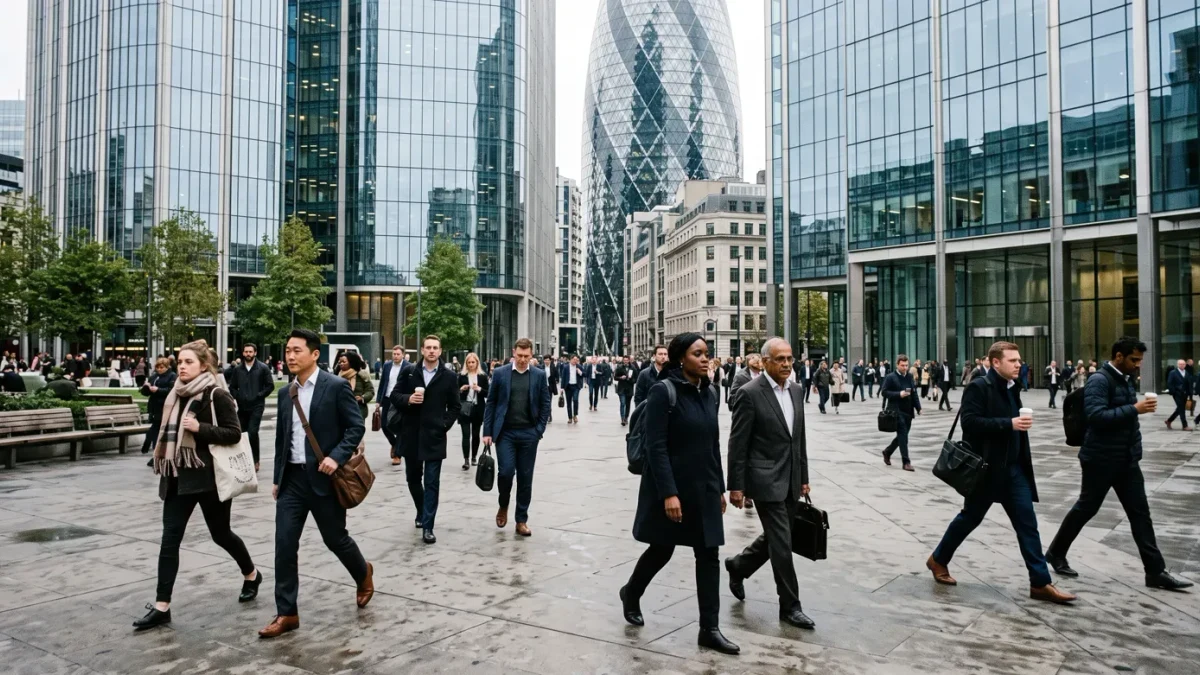
Silicon Valley wrote the software that lets a company run from a bedroom, and yet by 2025 many of the same employers, Amazon requiring five office days a week starting January 2025 and Google, Apple, and Meta enforcing three, sat at the strict end of American return-to-office policy, per company announcements. The contradiction is the defining workplace story of the decade, and it is measurable: per Kastle Systems badge data, San Francisco office attendance has hovered near or below half of pre-pandemic levels for much of the period since 2020, while CBRE reports put the city's office vacancy among the highest of any major US downtown, above 30 percent.
This explainer untangles why the region that invented remote work wants its workers back, what the standoff has done to San Francisco and San Jose, and what both sides of the desk have actually learned.
Why do companies want people back?
Executives cite collaboration, mentorship, culture, and speed, and there is a harder logic underneath. Management reporting, apprenticeship of junior engineers, and the informal problem-solving that happens at whiteboards are all easier to verify in person, and several chief executives have argued publicly that innovation requires proximity. Commercial real estate adds a quieter motive: companies lease millions of square feet on long contracts, and empty offices are balance-sheet waste. There is also, analysts note, an element of workforce management that rarely appears in memos, since office mandates function as a soft exit program for employees who value remote life more than the job.
Employees answer with commute math. Bay Area commutes rank among the longest in the country, housing near the job centers is the most expensive in America, and the census's own surveys during the pandemic years ranked San Francisco and San Jose among the nation's leaders in work-from-home share. For a engineer renting in Sacramento or Reno, an office mandate is not a culture policy but a relocation order.
What has the standoff done to the region?
Downtown San Francisco became the visible ledger. Office vacancy above 30 percent per CBRE reporting emptied lunch businesses and transit lines, cut the city's business tax base, and turned the 2024 mayoral election into a referendum on downtown recovery. San Jose and the peninsula office parks absorbed similar hits. Meanwhile the workforce dispersed: many Bay Area employees moved inland or out of state while keeping California employers, spreading paychecks across the western states and complicating the tax and housing politics of the region that used to capture them all.
| Company | Office policy as of 2025 |
|---|---|
| Amazon | Five days per week from January 2025 |
| Three days per week since 2023 | |
| Apple | Three days per week since 2022-2023 |
| Meta | Three days for most roles from 2023 |
| Smaller startups | Mixed; many remain remote-first |
How the region got here in the first place
The irony has a history. Silicon Valley firms spent the 2010s marketing collaboration software, video calls, cloud documents, and chat, that made distributed teams viable, and a small but real remote workforce predated 2020. The pandemic then ran the largest workplace experiment in history on infrastructure the Valley itself built, and for two years the results looked decisive: output held, meetings shrank, and workers relocated without visible productivity collapse. The 2022 and 2023 wave of layoffs changed the negotiating power behind that experiment. With hiring frozen and redundancy threats credible, executives revived mandates that would have triggered mass departures in 2021, a shift labor analysts read less as evidence about productivity than as evidence about leverage.
The region's commuting culture adapted in stages. Transit agencies cut service and then rebuilt routes around midweek peaks, parking economics at suburban campuses reversed, and the Friday ghost town became a permanent fixture of Bay Area downtowns even at companies with mandates. Each adaptation hardened expectations on both sides, which is why the dispute now plays out through attrition and hiring language rather than dramatic confrontations.
For California's budget writers the stakes are concrete: income tax follows the worker, and remote migration has already shifted revenue growth toward inland counties and neighboring states, a fiscal leak that no office memo fully recalls.
Is the office actually winning?
The scoreboard is mixed, which is why the story keeps generating news. Badge data shows attendance recovering from the 2020 collapse but plateauing well below 2019 norms, and enforcement is inconsistent: the same companies that announce mandates also post remote roles, and quiet exemptions follow scarce specialists. Surveys of Bay Area employers through the mid-2020s describe a settled hybrid equilibrium, roughly two to three office days as the regional standard, with the five-day companies standing as outliers testing whether attrition among senior staff is acceptable. Remote-first startups continue to hire from anywhere, keeping pressure on incumbents at the margin.
The generational split inside companies matters as much as the policy split between them. Executives in their fifties built careers on apprenticeship that happened in hallways, and they genuinely fear that remote-first firms will fail to train the next cohort of senior engineers. Workers under thirty face the opposite trade: their careers benefit from proximity, but their finances collapse under Bay Area rents, and surveys consistently show younger employees ranking remote flexibility among their top job criteria. Companies are effectively arbitrating between a training model and a housing market, which is why the debates never resolve with data about productivity alone.
What to watch
Watch whether Amazon's five-day model spreads or stalls through late 2026, and how San Francisco's downtown conversion pipeline, offices becoming housing, changes the arithmetic for employers deciding between empty floors and forfeited leases. The region invented the remote-work future and then hedged on it; the resolution will be measured one badge swipe at a time.