California sits on some of the most active ground in the United States, and the shaking residents feel is the crust adjusting along faults. According to Wikipedia's overview of California, two-thirds of the nation's earthquake risk lies in California. That figure does not mean a large quake is always imminent. It means the state carries most of the country's exposure, so understanding what the numbers mean is part of everyday life here.
The shaking comes from tectonic plates, the large pieces of the Earth's crust that grind past each other underground. As the Simple English Wikipedia notes in its California entry, earthquakes happen when those plates shift, and Californians respond by keeping extra food, water, flashlights and first aid supplies on hand. This guide explains what magnitude actually measures, why some quakes damage buildings that others do not, and what preparedness looks like in practice.
What does a quake's magnitude number actually mean?
Magnitude describes the size of the quake at its source, not the damage at your house. A bigger number means the fault moved with more energy. The scale is not a simple ladder: each step up represents a large increase in energy released, which is why a magnitude 6 is far more serious than a magnitude 4, not just a little more.
The same magnitude can feel very different depending on distance, depth and ground conditions. A deep quake far offshore may barely rattle a kitchen. A shallow one under a neighborhood can knock books off shelves. So when you hear a magnitude reported, treat it as a measure of the event itself, and wait for local reporting to learn what it did to the places people live.
Why does California have so many fault lines?
The state sits where two of the Earth's plates meet, and the boundary between them is not a single clean crack. It is a zone of many faults running through populated regions. When stress builds along one of these faults faster than the rock can absorb it, the rock slips, and that slip is the earthquake.
Because the faults thread through the state rather than sitting at its edges, quake risk is not confined to one region. Communities from the coast to the desert live with it. That is the practical meaning of the claim that two-thirds of national earthquake risk sits in California: the hazard is spread across where most Californians actually live, not parked in an empty corner of the map. Readers following this should also see Why California Gas Prices Run Higher Than the Rest of the Country.
Does a small quake mean a big one is coming?
This is the question people ask after every rattle, and the honest answer is that a single small quake does not reliably predict a large one. Most small earthquakes are simply small earthquakes. Seismologists study sequences of quakes to judge whether activity on a fault is unusual, and that judgment is theirs to make with data, not something a resident can infer from one jolt.
What this means for daily life: treat any quake, however minor, as a reminder rather than a forecast. Check that your water heater is strapped, that heavy shelves are anchored, and that your emergency supplies are where you think they are. The quake itself tells you little. Your readiness tells you more.
What can households actually do to prepare?
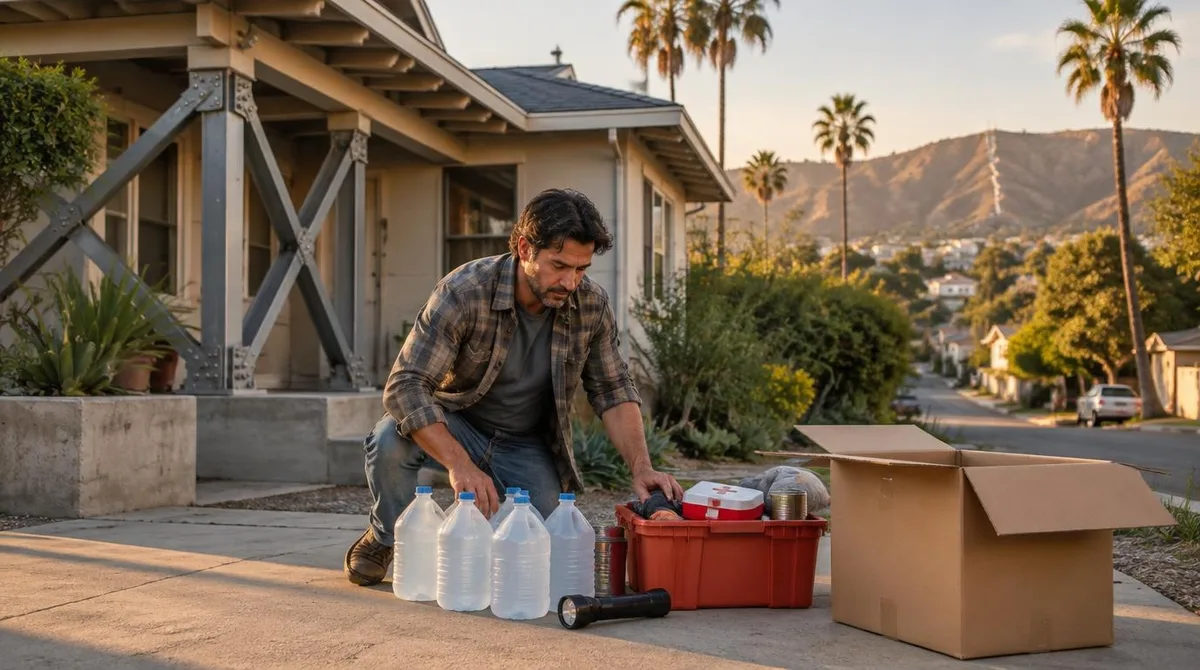
Preparation in California is ordinary household maintenance, not a special project. The Simple English Wikipedia's description of the state's habits captures it plainly: Californians often store extra food, water, flashlights and first aid supplies in case of an emergency. Those basics cover the most common aftermath of a damaging quake, which is disrupted water and power rather than collapsed streets. We covered a connected angle in CEQA, Explained: The Law That Shapes Almost Every California Building Project.
- Keep water and shelf-stable food stored where you can reach them without power.
- Keep flashlights and a first aid kit where every household member can find them in the dark.
- Secure tall furniture and anything heavy above a bed or couch.
- Know how to shut off gas and water at your home, and practice it once.
Our analysis of the reporting pattern: coverage after quakes tends to focus on magnitude, while the household consequences run through water, power and transportation. A household that has covered those basics has done most of what preparation can do.
How do quakes fit into California's other hazards?
Earthquakes are one entry in a long list of natural hazards the state manages, alongside wildfire, drought and flood. The same pattern holds across that list: the hazard is regional, the risk is concentrated where people live, and the state's response runs through building rules, agency staffing and local government. Readers who want the wider weather picture can see how the state's weather patterns work for newcomers, since drought and heavy rain shape how ground and hillsides behave.
The through line is that California's environment is not calm, and the state's institutions are built around that fact. Quakes are simply the hazard that gives no seasonal warning. Fire has a season. Flood has a storm forecast. An earthquake arrives unannounced, which is why preparation, not prediction, is the strategy the state and its residents actually rely on.
What this means for how you read quake news
When the next quake makes headlines, read past the magnitude. The useful questions are local: How deep was it? Where was the epicenter relative to towns? What did inspectors find in schools, bridges and hospitals? Those answers, not the raw number, tell you what changed in your life.
The evidence here establishes the basics: California carries most of the nation's earthquake risk, the shaking comes from shifting tectonic plates along a network of faults, and the standard household response is stored supplies and secured furniture. What remains unknown, in any given week, is when and where the next slip will come. No source in this piece supports a prediction, and readers should treat anyone offering one with skepticism. The state's own habits, storing supplies and building to code, are the honest answer to an unscheduled hazard.