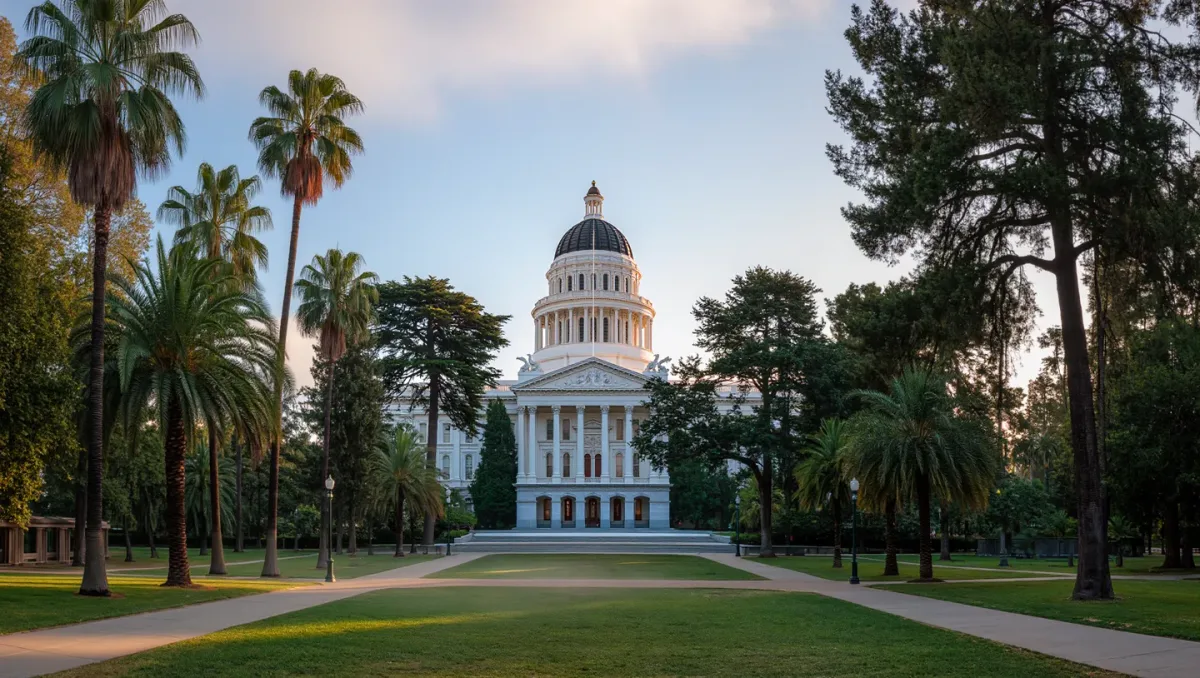
Sacramento has been California's capital since 1854, but it was the state's fifth choice, after San Jose, Vallejo, Benicia, and a brief period of chaos in which the Legislature met in rented rooms and saloons, per records summarized by the California State Archives. The domed classical building at the head of Capitol Park, whose construction began in 1860 and stretched to 1874, has outlasted floods, fire threats, and a major restoration to remain what it was designed as: the working office of California's lawmaking power, not a museum piece.
The building's history explains a good deal about the state itself, from the haste of the Gold Rush legislature to the modern underground annex where most of the actual staff work happens.
How did Sacramento win the capital?
The first Legislature convened in San Jose in 1850, but the town offered little in the way of facilities or incentives, and legislators began shopping for better terms. General Mariano Vallejo promised land and money for a new capital at Vallejo, which failed to materialize adequately; the session moved to Sacramento in 1852 amid flooding, retreated to Benicia, and finally landed back in Sacramento in 1854, where county voters and city leaders offered usable buildings and a growing river-trade economy. Floods remained the hazard; in 1862 the Legislature reportedly reconvened in San Francisco for a period after the great flood submerged the city, and levee building became the city's permanent side business, per historical accounts compiled by state archives and the Sacramento History Museum.
What was built, and when?
The building that settled the question began with a design that drew on the classical revival vocabulary popular for statehouses in the Civil War era, with a central domed rotunda and symmetric wings housing the two chambers. Construction began in 1860, proceeded through fits of funding and flood, and the building was substantially complete by 1874, per California State Parks documentation. The wings grew over time, an annex expansion in the mid-twentieth century added modern office space, and by the 1970s the aging structure faced demolition proposals that preservationists defeated. A comprehensive restoration, completed in the early 1980s, returned the building's historic sections while modernizing its systems, and the result is a functioning capitol whose public floors double as a state historical park.
| Year | Milestone |
|---|---|
| 1850 | First Legislature meets in San Jose |
| 1854 | Sacramento becomes the permanent capital |
| 1860-1874 | Capitol construction |
| 1950s | Annex expansion adds modern offices |
| 1982 | Historic restoration completed |
Why the capital question kept resurfacing
The Legislature's early wandering reflected the state's founding economics. Gold Rush California grew faster than its institutions, and cities bid for the prestige and payroll of the seat of government the way modern regions bid for sports franchises, with land, buildings, and cash. San Jose offered little capital construction; Vallejo's promise collapsed under its namesake's finances; Benicia hosted the Legislature in a city hall built for the purpose; and Sacramento won on the practical merits of a river port with hotel rooms, a county courthouse, and a business community that understood what a legislative session did to local commerce each winter.
Once installed, the capital became self-reinforcing. Sacramento's economy reorganized around state employment, the county built institutions to serve the sessions, and every later proposal to move the government north or south has run into the arithmetic of relocating an entire administrative city. That same gravity explains the modern skyline: office towers serving state contracts and lobbying firms line the blocks between the Capitol and the river, a direct descendant of the 1850s incentive packages.
Who works in the building now?
The historic core hosts the Assembly and Senate chambers, the Governor's ceremonial office, and the museum rooms visitors tour for free. The everyday machinery sits next door: the East Annex tower and the underground addition completed in the early 1990s hold member offices, staff, hearing rooms, and the constant traffic of lobbyists and press. The grounds themselves are a working archive of the state's identity, with trees planted from around the world in Capitol Park and memorials added by each generation, from the Civil War memorial to the Vietnam memorial and the Medal of Honor Grove.
Security has reshaped access over the decades, most sharply after the 2001 demonstrations and in the years since, but the building retains the accessibility its nineteenth-century designers assumed, with committee hearings open to the public and the chambers visible from visitor galleries whenever the houses are in session.
Visitors planning a stop should time it to the calendar. On session days the galleries above each chamber carry the best show in Sacramento, a floor debate conducted under nineteenth-century frescoes, and hearings in the annex overflow into hallways. In summer the building empties toward district offices and Capitol Park absorbs the events, from concerts to demonstration days, that the grounds have hosted since the first trees went in. Either way the experience is the same argument the building has made since 1874: this state wanted its government visible, central, and open, and it built accordingly.
What to watch
Watch the continuing renovations and seismic upgrades that each generation of statehouse stewards leaves for the next, and the recurring proposals to move or decentralize state functions, which surface in every budget crunch and never quite succeed. Sacramento's grip on the capital dates to 1854 because the buildings, the staff, and the archive are the capital; the dome is the address, but the institution is what cannot be moved cheaply.